Lost...and Found with Lifeseeker, a Heli Rescue Transmitter

This story is being republished from its original release date of May 27, 2020, with updated info and new photos.

Let’s say you are backpacking in the middle of the Gros Ventre Wilderness, or deep within a remote canyon in the Jed Smith. Somehow, you unfortunately break your leg. Without having cellular service and being very far from help, what do you do?

TCSAR volunteer Lexie Drechsel uses Lifeseeker during a training on May 24, 2022, to find a cellular device where no cellular service exists.

If you can, send someone for help and hunker down as best as possible. But even then, that leaves many questions about the outcome of your potential rescue: How long can you last due to exposure? What about weather, wildlife, and the seriousness of your injury? 

These situations, though rare, occur when someone becomes stranded, lost, or incapacitated in a wilderness environment, leading to extended rescues involving dozens if not hundreds of people searching for clues of your whereabouts.

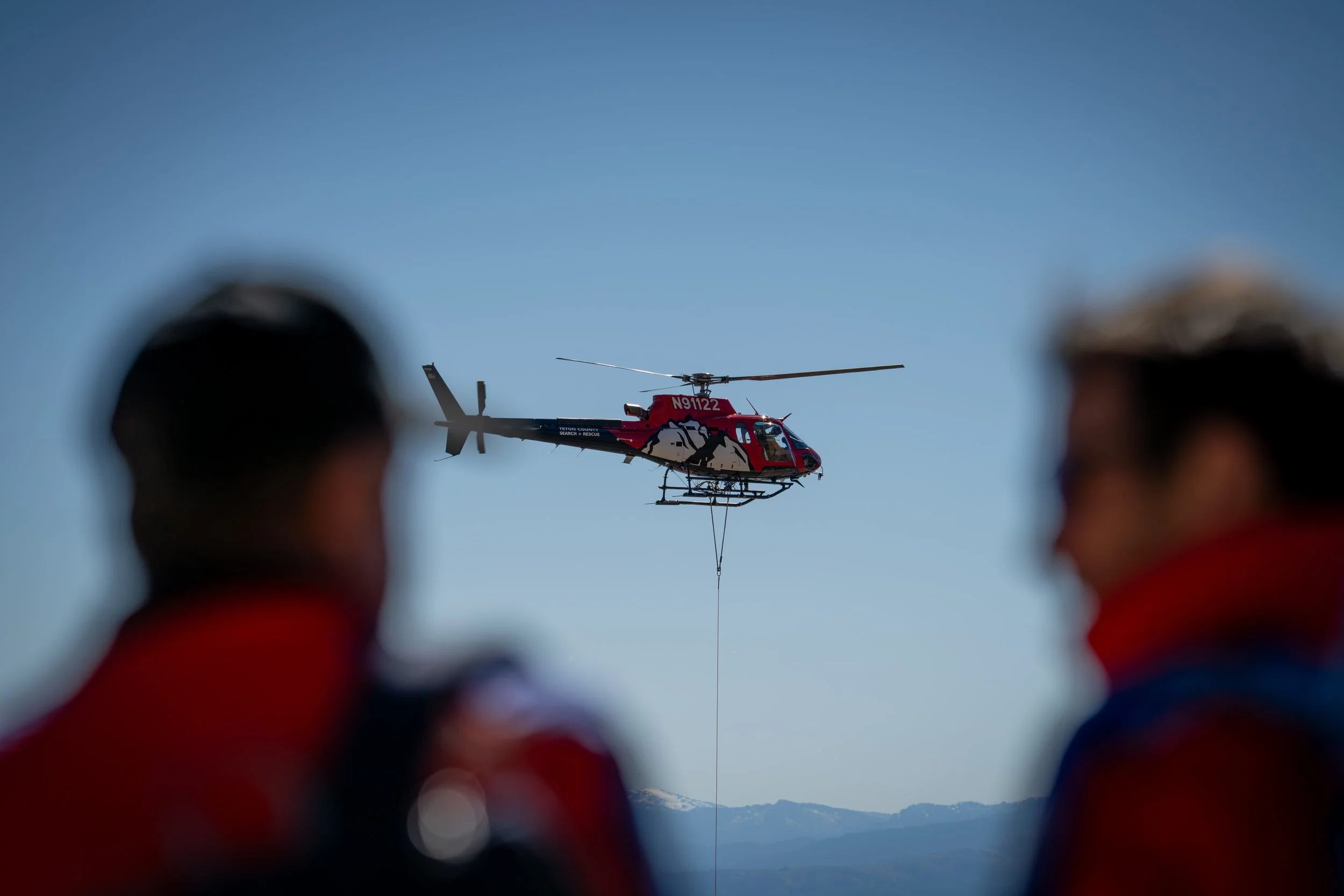
But thanks to one of the more unique tools within the Teton County Search & Rescue toolkit, you might be found in a much quicker fashion. Known as Lifeseeker, this aircraft-mounted cellular transmitter enables a helicopter search team to locate you based on the pings in the cellular network—even when there is no cellular service. 

“Lifeseeker is another tool in toolbox and I think it’s amazing that TCSAR has access to this technology,” says TCSAR volunteer Lexie Drechsel, who joined the team in 2021. “I feel very fortunate to have been able to be part of multiple trainings this spring, running several iterations with Lifeseeker. In the case of a missing/injured party of unknown location, it’s a huge asset that we have multiple team members trained and prepared to operate the technology smoothly.”

When activated, Lifeseeker effectively acts as an airborne cellular transmitter, allowing a helicopter search team to pick up and locate specific numbers coming off your phone. When your phone is powered on and not in airplane mode, it constantly sends out a unique IMEI number (think of it as a digital fingerprint) to connect with the nearest cell tower. If the SAR team knows that IMEI number, they can hone in on its exact location as the number is transmitted through Lifeseeker. When Lifeseeker picks up on the IMEI, the location is displayed on a pair of iPads connected to a primary controller box. Both rescuer and pilot have iPads so they each both see the location of the device.

TCSAR pilot Steve Wilson hones in on a lost subject using Lifeseeker during a training on May 24, 2022.

In other words, when Lifeseeker passes overhead inside the TCSAR helicopter, it acts as a temporary service provider, connecting your phone to the team inside.

“Once we have a confirmed location, we can send a text message to that device, and, if able, someone can text back,” says TCSAR team member Eric Helgoth, a volunteer since 2004. “However, if we fly over looking for phone X, and phone Y sees they have a cell signal, phone Y can’t use that signal.” 

Nor does TCSAR have the ability (and, it should be noted, the desire) to block or interfere with anyone’s cellular service. Lifeseeker is simply a rescue aid. Designed by a Spanish firm, Centim, this is the first such device in use in the U.S. TCSAR obtained it through an anonymous donor.

“We’ve got a dozen different ways to find someone,” Helgoth says. “It’s just one more tool in our toolbox. It’s not going to work in every instance.”

Turn it up to 11. Utilizing cellular phone technology, Lifeseeker is yet another tool to help find and rescue people in need. PHOTO: TCSAR Foundation

Turn it up to 11. And if you’re lost, keep your phone charged up and on so Lifeseeker can find you.

For example, Lifeseeker won’t find you if your phone is turned off or in airplane mode. It is only able to receive and transmit phones that are actively seeking a cell tower. So it’s a good idea to bring a backup power source, and make your phone active if you know you’re being sought by Search & Rescue. Goal Zero makes some great power banks for rugged outdoor use, as does Outdoor Tech. 

TCSAR has a range of options to do helicopter searches depending on the rescue scenario. One is the RECCO SAR Helicopter Detector, a 174-pound drum that hangs 15 meters (about 49 feet) below the helicopter. Flying 300 feet above the ground at 60 mph, the detector scans 600 square feet every second. The team also has a heli avalanche beacon, which picks up signals from buried avalanche transceivers.

Another useful took from TCSAR is Backcountry SOS, a free app that allows a user to text an emergency directly to 911 in Teton County. The app is now available in 12 counties across the West, and has been used to save lives in Jackson Hole.

Join This Amazing Race on June 5 to Support TCSAR!

The Ultimate Towner Amazing Race takes place on June 5 and benefits TCSAR


The 9th annual Ultimate Towner will take place on Sunday, June 5, throughout the town of Jackson, starting and finishing at Phil Baux Park. TCSAR Foundation is honored to be the official event beneficiary.

Designed this year as an Amazing Race, teams will need to strategize on their approach to complete as many checkpoint challenges as they choose over a two-hour time frame. For example, teams could begin the event by heading to locations near Mike Yokel, Rodeo Grounds, or the Town Square first. 

“I am excited to offer this new format and to continue the tradition of the Towner. There is a lot of heart that goes into creating and delivering this experience by all involved. This event is for locals and one that will celebrate the uniqueness of our town and community,” said Tim Walther, Event Director and CEO of Grand Dynamics. 

For more info and to register, go to the Ultimate Towner event page.

TCSAR Helps Loved Ones Reunite with Family and Friends

Community Support for Heli-Yes! Truly Makes a Difference

On February 6, 2022, Tanner Ellis broke his C5 vertebrae during a snowmobile trip with friends on Togwotee Pass. It was the very first morning of a planned weeklong trip and Tanner, a 23-year-old from Elk River, Minn., had already completed one ‘re-entry’ on his snowmobile. A ‘re-entry’ is a trick where you drive your sled into a wheelie up a steep slope before flipping it back 180 degrees and landing in the same track on the way down.

On his second attempt, the sled fell back on top of him, ‘mousetrapping’ him beneath it. In addition to his neck injury, he also broke his tibia plateau and received a concussion (he was wearing a helmet). When he came to, he could not feel his arms or legs.

Tanner Ellis with a new sled in Pine Island, Minnesota. Courtesy photo.

We're bringing you Tanner's story as our Heli-Yes! campaign wraps up this week. The team’s rescue of Tanner was just one of more than 20 heli missions this winter. With just a few days left, we couldn't be happier to announce that with your help, we've met an anonymous local donor's $35k challenge match, putting us over $70k specifically intended for TCSAR's helicopter operations next year.

With the Teton County Sheriff's Office budgeting for eight months of on-call TCSAR helicopter service, support for Heli-Yes! means volunteers will get the flight time and training necessary to fully utilize the best tool available for saving lives in the backcountry. It truly does make a difference, and goes directly to helping people like Tanner. The team extends its sincere gratitude to everyone who donated.

"There’s no replication or substitute for a helicopter in mountain rescue,” says TCSAR Chief Advisor Cody Lockhart. “It is a vital tool for the team and the community. We’re incredibly grateful to have such great grassroots community support for this resource."

On the day of Tanner’s accident, TCSAR got the call just before noon. The team responded with a helicopter and snowmobile teams. The weather was good that day for flying, and the heli was able to land upslope from Tanner, where volunteers then skied down to him. They then loaded him into the ship for transport to an ambulance within just a few hours of his accident. Plan B would have involved a toboggan to tow him behind a snowmobile over several miles of undulating terrain, a process that would have been much lengthier and perhaps exacerbated Tanner’s injuries.

TCSAR volunteer Dr. AJ Wheeler provides patient care to Tanner Ellis on February 6, 2022. Courtesy photo.

“When the snowmobile landed on top of me, I got knocked out. Either right before or after, the craziest feeling went through my body,” Tanner says. “You can just feel everything turn off. My visor smashed over my goggles so I couldn't really see what happened and I couldn't feel anything. I couldn't move anything. The first thing I said (to my friends) when I woke up is ‘Don't touch me,’ because I knew something was real bad.”

After emergency surgery, a ton of physical therapy and determination, Tanner is now walking, going to the gym, and heading back to work next week as an apprentice lineworker. He plans to continue to ride his snowmobile, but perhaps with a wider margin for error.

"The way I see it, the helicopter was the only way I was getting out of the backcountry,” he says. “I am very thankful it was a bluebird day, and for all the help of TCSAR."

Tanner’s full story, including how TCSAR members organized the response to his injuries, will be the subject of an episode of The Fine Line podcast, scheduled for release on May 26, 2022.

Tanner, above middle, with his sisters, Madison and Kenzie, and parents, Scott and Michelle. Courtesy photo.