TCSAR + Foundation Featured in New Film about Mental Health

First responders are often portrayed as being tough, burly, strong, physically fit…pick your adjective… And yes, they are all of those things, but they also experience rates of depression and suicide ideation far greater than the general population.

The dangers and stress of the job make first responders—no matter how tough they appear on the outside—susceptible to traumatic stress injuries. Just as physical injuries require medical attention, so do stress injuries. And while first responders have traditionally been expected to ‘suck it up’ and ‘be tough’ after dealing with stressful or traumatic events, that expectation doesn’t reflect the reality and dangers of stress injuries.

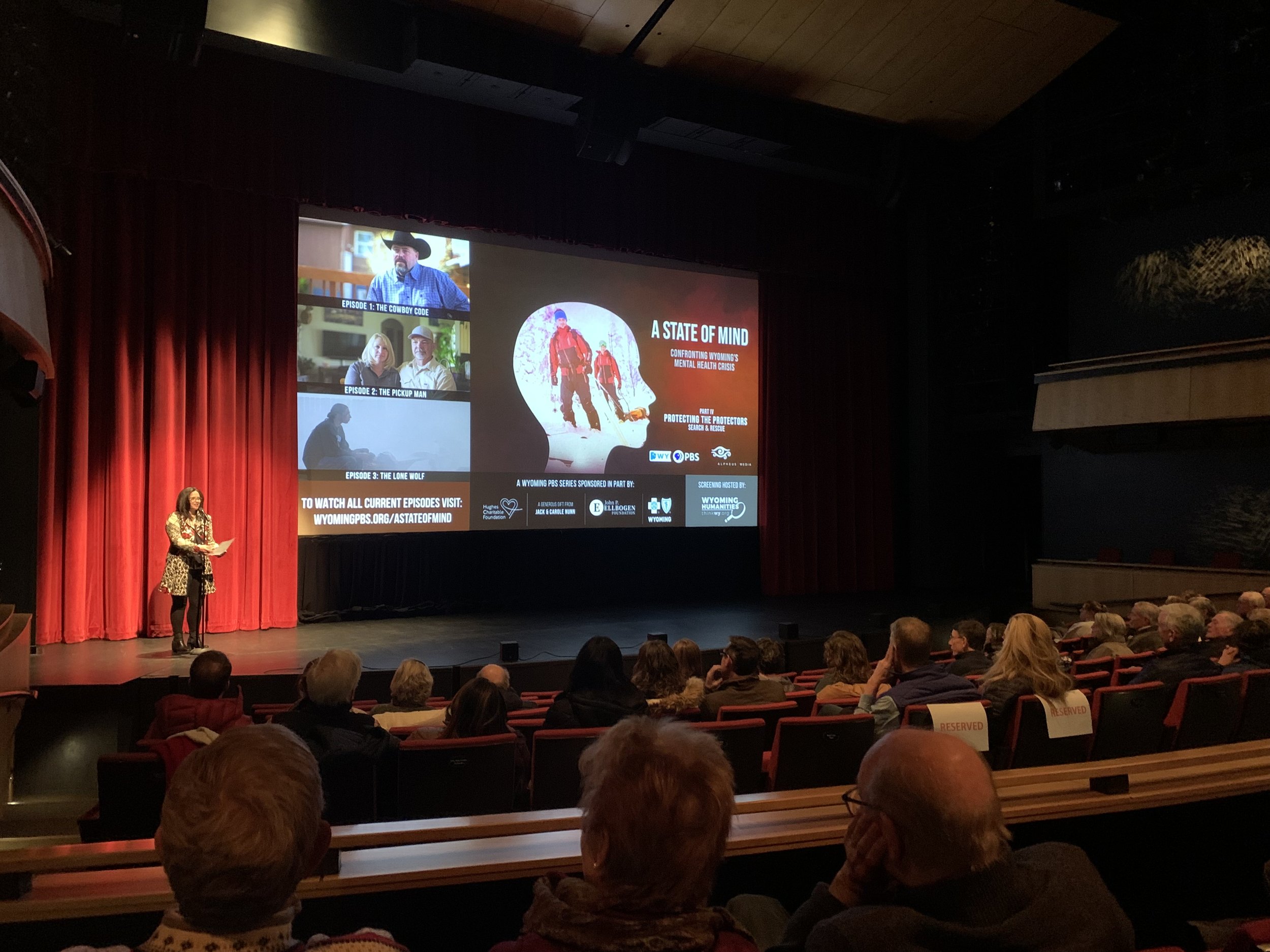
This issue is the focus of a new film called “A State of Mind: Protecting the Protectors,” part of a new series on mental health currently showing on Wyoming PBS. The film premiered in Jackson on February 9 at the Center for the Arts, and will be broadcast on Wyoming PBS later this spring.
Watch "A State of Mind" Series on Wyoming PBS

Joanna Kail, Executive Director for Wyoming PBS, introduces the film “A State of Mind: Protecting the Protectors” at the Center for the Arts on February 9. Photo: TCSAR Foundation

Featured in the film are TCSAR volunteers Stephanie Thomas and Jen Reddy; Drew Kneeland, director of the Jackson Hole Ski Patrol; licensed therapist Lewis Smirl; Katie Davis from Jackson Hole Fire/EMS; and others who are working to provide a positive influence on mental health in Teton County and across Wyoming. The film provides an excellent look into the efforts from different individuals and organizations to eliminate the stigma around mental health as part of the TIPS program.

In 2019, TCSAR Foundation and several other local first-responding agencies launched the Teton Interagency Peer Support (TIPS). TIPS provides free mental health support for local first responders and their families, and is funded through private donations and grants. Since its inception, TCSAR Foundation has administered the program and accepted donations on behalf of the partner organizations. The TIPS’ approach gives first responders a network of peer support that works to keep them resilient, mentally strong, and of course, muscle bound.

Thank you to Alpheus Media for producing this important film and including TCSAR.

If you or a loved one is in need of mental health support, please know that help is available.

Contact the Jackson Hole Community Counseling Center at (307) 733-2046, or St. John’s Health Wellbeing Resources at (307) 203-7880.

The National Suicide Hotline offers 24-hour crisis support at (800) 273-TALK (8255), en Espanol (888) 628-9454.

Learn about TIPS

TCSAR Performs Midnight Rescue for Lost Skiers

Jackson, Wyo. — On Saturday night, January 28, Teton County Search & Rescue volunteers were called to respond to help two skiers who’d become lost in the Jackson Hole Mountain Resort backcountry. It ended up being a late night for search teams. The rescued men have been cooperative and are regretting their mistakes, explaining that by sharing their experience they hope that others don’t commit similar errors.

TCSAR volunteers exit the JHMR backcountry gates to rescue two lost skiers on Saturday night, January 28. Photo: TCSAR

The incident serves as a reminder to make sure you check the avalanche forecast, have the proper equipment and a plan before heading into the backcountry.

At 3 p.m. on Saturday, two skiers from Utah took the aerial tram to the summit with the plan of exiting into the backcountry to ski Rock Springs, an out-of-bounds, uncontrolled area to the south of JHMR. Instead, they mistakenly dropped into the top of Granite Canyon, a large avalanche-prone canyon that leads into Grand Teton National Park. When the skiers did not show up to meet their friends after the lifts closed, one friend put in a call to Jackson dispatch at 5:28 p.m. 

Unified command was set up with TCSAR, Grand Teton National Park, and JHMR ski patrol to begin formulating a search plan. With the Tetons having received roughly 4 feet of snow the previous three days, the avalanche danger was rated ‘high.’ The Bridger-Teton Avalanche Center’s forecast for January 28 stated: “Human triggered avalanches will be likely at all elevations today, with very dangerous avalanche conditions above 9,000 feet.”

When exiting the backcountry gates, always have knowledge of the conditions, proper safety equipment, a partner, and a plan. Photo: TCSAR

Without knowing the exact location of the two men, unified command believed the risk was too high to send teams blindly into the field at night. But at 8:10 p.m., a friend received a call from one of the skiers, but the call quickly dropped. Searchers zeroed in on the coordinates from the phone call, putting the skiers’ location in the area known as the Jersey Shore, a large and dangerous cliff band at the top of Rock Springs that has been the site of numerous accidents over the years. 

In an interview on Monday morning, one skier said they realized their mistake after dropping into Granite and were able to hike back up to the saddle above Rock Springs. One of their phones had died, and they were trying to conserve the battery on a second device. “It was five or six hours before we were able to get a hold of anyone,” he said.

Tired and cold, they decided to wait until rescuers could arrive. The skier confirmed that they did not have avalanche safety equipment. “We knew that if we didn’t get out of there, it might be game over," the skier said.

Only after knowing the skiers’ location did TCSAR put volunteers into the field. “We felt that at that time, we could do it safely,” said TCSAR Chief Advisor Cody Lockhart. 

At 10:45 p.m., nine volunteers skied out the top gate equipped with avalanche safety equipment, extra layers, food, and energy drinks. They made voice contact with the two men at 11:06 p.m. To avoid putting themselves in avalanche danger, the volunteers persuaded the two skiers to walk straight up the hill a short distance to where they could greet them with warm clothing and food. 

After locating the two skiers just before midnight, TCSAR helped the men put snowshoes on their feet to walk back up to the top station of the aerial tram. Photo: TCSAR

At that point, the volunteers put snowshoes on the men and helped them walk back up the ridgeline, reaching the top tram station at 12:50 a.m. The tram transported everyone down the mountain, where friends met the men and transported them to St. John’s Health for further care. TCSAR volunteers returned to the hangar at 1:35 a.m.

During the Monday interview, the skier was remorseful, apologetic, and expressed gratitude for the rescue teams. 

“It really comes down to being overconfident in knowing the terrain, overconfidence in backcountry knowledge, and not having a plan,” he said.

TCSAR appreciates the cooperation from JHMR and GTNP. In a statement, JHMR’s Director of Risk and Safety Jon Bishop said, “It’s a good reminder to have the appropriate knowledge, gear, a partner and a plan. We are thankful everything turned out OK.”

Media contact: Matt Hansen, TCSAR Foundation Communications Director, matt@tetoncountysar.org; (970) 846-7766